

A Beginner’s Guide to Food Photography- Part 2
Have you ever wondered why some photos feel airy and bright and others feel mysterious and dark. It all boils down to the contrast of light.
Contrast of light is the ratio between the highlights and shadows.
If the contrast between the highlight and shadow is high, the light and image is considered a high-contrast light. There is a drastic transition between the light and shadow.

If the contrast between the shadow and the highlight is small or minimal, then the light is said to be a low-contrast light. There is a gentle transition between light and shadow side.
Continuing our studies with a bowl of apples, below is an example of a high contrast image:
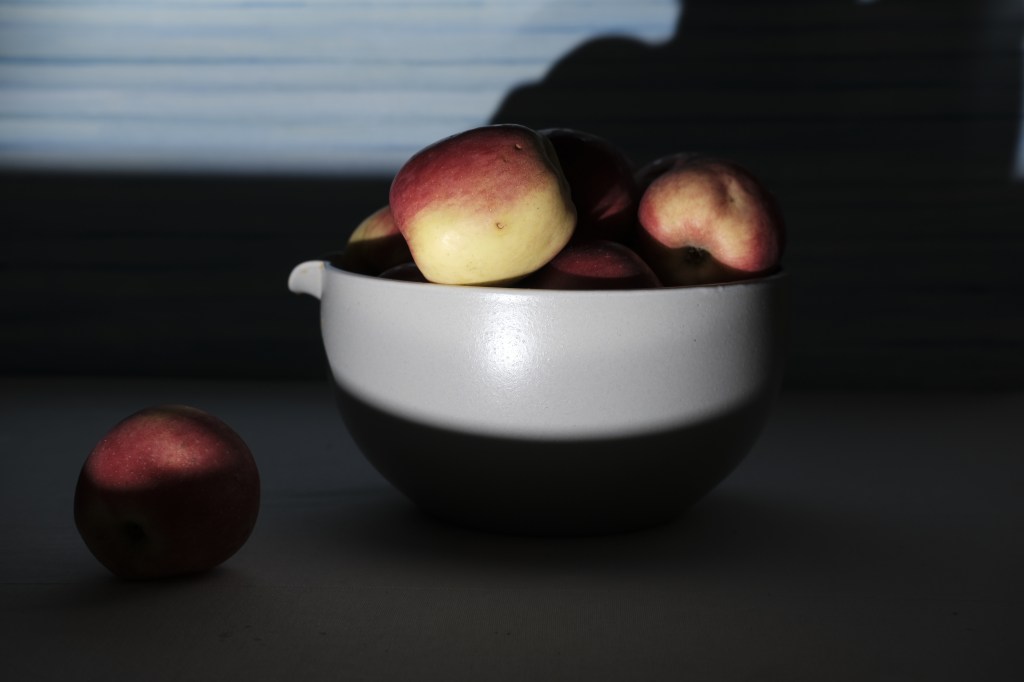
Check out the contrast between the light and the shadow. You can say the highlight is 4 time brighter than the shadow.
A light source has high contrast if:
- If it strikes the subject from one angle.
- Light does not enter the shadow area
- shadows are sharp and clearly defined
- These are caused by hard light creating a hard shadow
Now compare the above picture with this low contrast image:
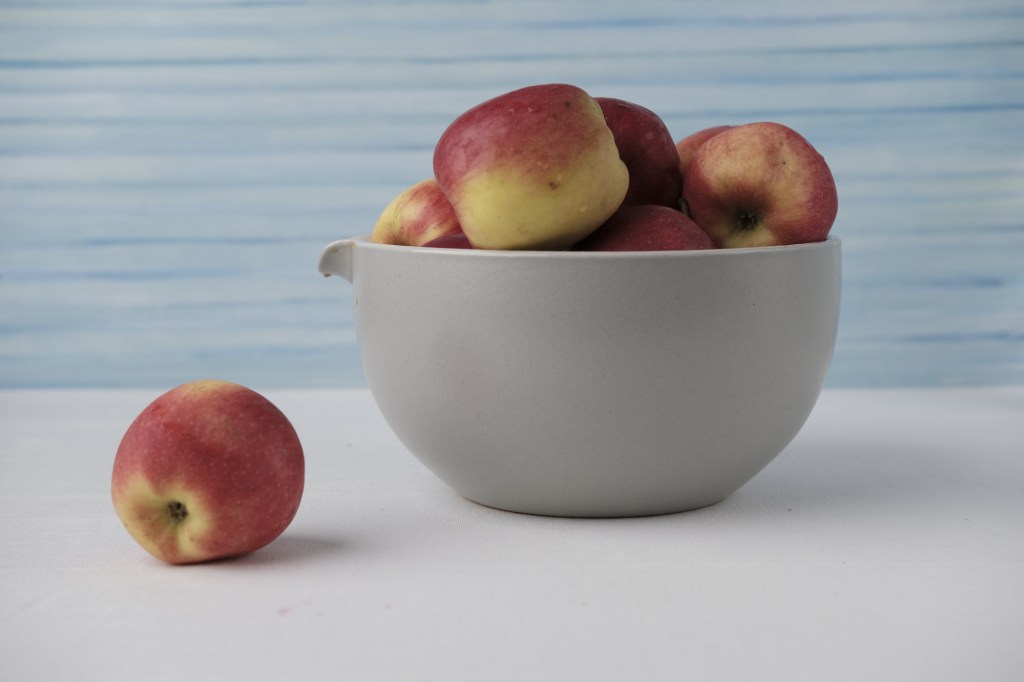
Observe the gradual transition from light to shadow.
A light source is said to be low-contrast if:
- Light rays strike the object at many different angles
- Light gets into the shadow area
- Shadows are blurred and not clearly defined
- Light producing soft shadows are caused by soft light
Note that we are using ‘hard’ and ‘soft’ to describe the edges of the shadow and not how dark or light the shadow is. A hard light can create light coloured shadows depending on the colour of the surfaces and surrounding objects. Like the image below

Although the image is not as contrasty as our first apple image, this image was shot with a hard light as the shadows are clearly defined. Multiple lights were used to create the above scene, so the overall tone is rather bright with light coloured hard shadows.
Contrast of light is one way to direct the viewers gaze in an image. However, there are various ways to apply contrast in photography.
In digital photography, we create contrasts by also using colour and composition. An image can have a high contrast with a low contrast light. For example, an image composed with black and white items will be considered high in contrast regardless of if it was shot with large (low contrast) light source with soft shadows..
Low Contrast vs High Contrast
Again, there is no science to a correct contrast ratio. Contrast is relative to the scene, story, the colour, the light, shape etc.
It is about knowing the narrative of your story. However some tips:
- If you want the viewer eye’s to lock in on the subject immediately, then a high contrast may be favourable as the eye’s will naturally focus on the brightest part of the image.
- If you want more of a gentler flow and viewer gaze then a low-contrast might be ideal.
- If you are want to create tension, anxiety- the high contrast can be an option
- If you want a relaxed, soft, calm image, then low contrast image will work.
- Consider the props, shape, material, and texture used. If you want to get some texture on the wall with a cucoloris or have shimmer when light is transmitted through a dense glass bottle, then use hard light.
- Study works of photographers- both in colour and black and white, look at art and compare contrasts. Notice the light contrasts during different times of day and weather conditions.
These are not absolutes.
Think broadly about the emotion you are trying to convey. Experiment and move the light around and express/imagine how you feel when you move the light or soften the light.
Let me know what you think in the comments below!
Chisom
 Team Nrinka